Consolation Series - Part 3

Yahweh said, “Because the cry of Sodom and Gomorrah is great, and because their sin is very grievous, I will go down now, and see whether their deeds are as bad as the reports which have come to me. If not, I will know.”
The men turned from there, and went toward Sodom, but Abraham stood yet before Yahweh. Abraham came near, and said, “Will you consume the righteous with the wicked? What if there are fifty righteous within the city? Will you consume and not spare the place for the fifty righteous who are in it? May it be far from you to do things like that, to kill the righteous with the wicked, so that the righteous should be like the wicked. May that be far from you. Shouldn’t the Judge of all the earth do right?”
Yahweh said, “If I find in Sodom fifty righteous within the city, then I will spare the whole place for their sake.” Abraham answered, “See now, I have taken it on myself to speak to the Lord, although I am dust and ashes. What if there will lack five of the fifty righteous? Will you destroy all the city for lack of five?”
Yahweh said, “I will not destroy it if I find forty-five there.”
Abraham spoke to him yet again, and said, “What if there are forty found there?”
Yahweh said, “I will not do it for the forty’s sake.”
Abraham said, “Oh don’t let the Lord be angry, and I will speak. What if there are thirty found there?”
Yahweh said, “I will not do it if I find thirty there.”
Abraham said, “See now, I have taken it on myself to speak to the Lord. What if there are twenty found there?”
Yahweh said, “I will not destroy it for the twenty’s sake.”
Abraham said, “Oh don’t let the Lord be angry, and I will speak just once more. What if ten are found there?”
Yahweh said, “I will not destroy it for the ten’s sake.”
Yahweh went his way as soon as he had finished communing with Abraham, and Abraham returned to his place.

Genesis 18:20-33

The story of Sodom and Gomorrah is often assumed to be about a wrathful God punishing bad behavior.  But the story really isn’t about that at all.  The vast majority of the text consists of an extraordinary discussion between Abraham and God in which Abraham ask God if He will spare the city if just a few innocent people can be found there.  God’s answer is inevitably, “yes.”

In the Biblical narrative, it sometimes seems like God’s concern is with the Israelites as a group rather than with each individual.  And in our lives, it is easy to feel very small and insignificant – one person in a world of billions.  We might ask, “does God take notice of me?”   The story of Sodom and the discussion between Abraham and God reveals that God does not love groups; He loves each of us as His unique creation and takes notice of each one of us as though we are the center of His universe. 

Jesus said something similar in the Gospel of Matthew:

Aren’t two sparrows sold for an Assarion coin? Not one of them falls on the ground apart from your Father’s notice, but the very hairs of your head are all numbered. Therefore, don’t be afraid. You are of more value than many sparrows. 

Matthew 10:29-33


Consolation Series - Part 2

Now Yahweh said to Abram, “Leave your country, and your relatives, and your father’s house, and go to the land that I will show you. I will make of you a great nation. I will bless you and make your name great. You will be a blessing. All the families of the earth will be blessed through you.”  So Abram went, as Yahweh had told him. Lot went with him. Abram was seventy-five years old when he departed from Haran. Abram took Sarai his wife, Lot his brother’s son, all their possessions that they had gathered, and the people whom they had acquired in Haran, and they went to go into the land of Canaan. They entered into the land of Canaan. Abram passed through the land to the place of Shechem, to the oak of Moreh. At that time, Canaanites were in the land.  Yahweh appeared to Abram and said, “I will give this land to your offspring.” (Genesis 12:1-7)

Yahweh said to Abram, after Lot was separated from him, “Now, lift up your eyes, and look from the place where you are, northward and southward and eastward and westward, for I will give all the land which you see to you and to your offspring forever.  I will make your offspring as the dust of the earth, so that if a man can count the dust of the earth, then your offspring may also be counted. Arise, walk through the land in its length and in its width; for I will give it to you.” (Genesis 13:14-18)

Yahweh brought him outside, and said, “Look now toward the sky, and count the stars, if you are able to count them.” He said to Abram, “So your offspring will be.” He believed in Yahweh, who credited it to him for righteousness. He said to Abram, “I am Yahweh who brought you out of Ur to give you this land to inherit it.” (Genesis 15:5-7)

When Abram was ninety-nine years old, Yahweh appeared to Abram and said to him, “I am God Almighty. I will make my covenant between me and you, and will multiply you exceedingly.” Abram fell on his face. God talked with him, saying, “As for me, behold, my covenant is with you. You will be the father of a multitude of nations. Your name will no more be called Abram, but your name will be Abraham; for I have made you the father of a multitude of nations.  I will make you exceedingly fruitful, and I will make nations of you. Kings will come out of you. I will establish my covenant between me and you and your offspring after you throughout their generations for an everlasting covenant, to be a God to you and to your offspring after you. I will give to you, and to your offspring after you, the land where you are traveling, all the land of Canaan, for an everlasting possession. I will be their God.” (Genesis 17:1-8)

I will bless you greatly, and I will multiply your offspring greatly like the stars of the heavens, and like the sand which is on the seashore. (Genesis 22:17)

___________________________

God promises that Abram will be the father of Judaism, Christianity and Islam which, taken together, today represent well over half the global population.  There is nothing in Abram’s backstory to suggest he deserves to be chosen for this immense blessing and honor.  In fact, Genesis tells us who Abram’s ancestors were, but doesn’t tell us anything else about him.  God’s choice appears to have been entirely random.   

But Abram’s story is more than just the history of world religion.  Abram’s name means, “father,” and the new name God gives him, “Abraham,” means “father of nations.”  We are not supposed to see Abram as a heroic, distant Biblical figure, but as being in our own immediate family and our direct decedent.  Abram represents each one of us and God’s unreasoning decision to take each of us as His very own.  

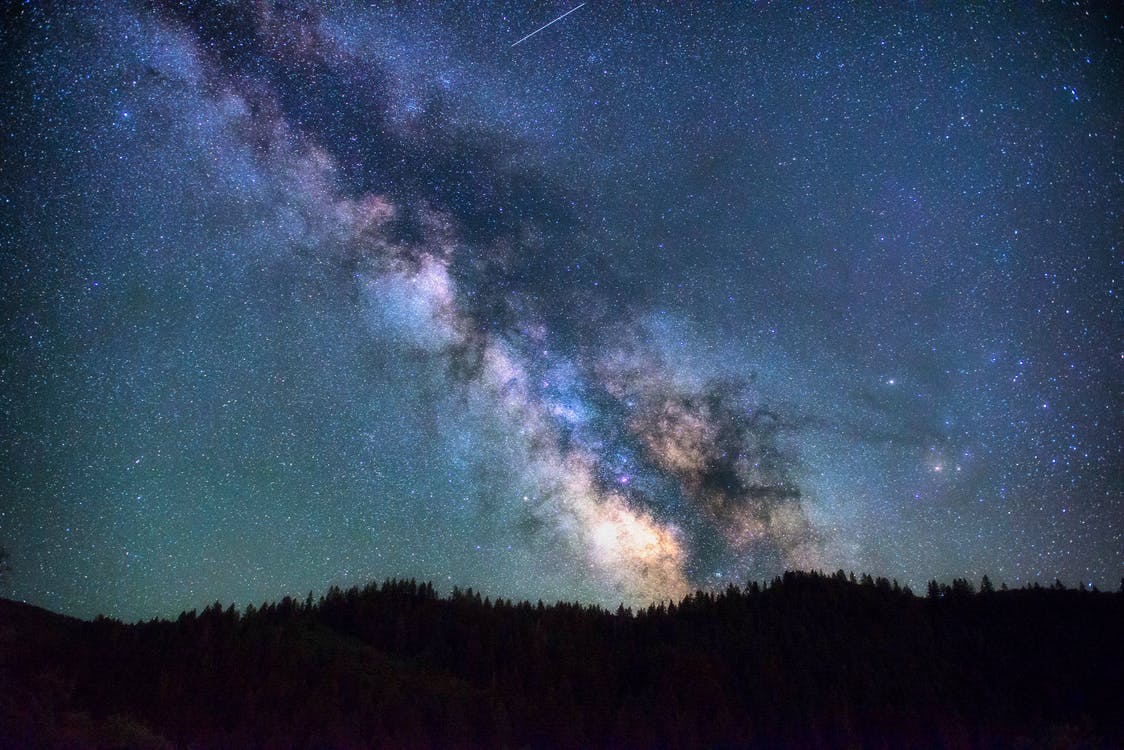
God repeats His covenant with Abram repeatedly as though to make sure we don’t forget it.   He speaks in the most evocative language:  He tells Abram to look in every direction to see the land God will give his children as an everlasting possession.  He invites Abram, and each one of us, to look up into the ancient starlit night sky and the sand on the boundless seashore to illustrate God’s abundant, eternal love. 


Consolation Series - Part 1

In the beginning, God created the heavens and the earth.  The earth was formless and empty. Darkness was on the surface of the deep and God’s Spirit was hovering over the surface of the waters.

God said, “Let there be light,” and there was light. God saw the light, and saw that it was good. God divided the light from the darkness. God called the light “day”, and the darkness he called “night”. There was evening and there was morning, the first day.

God said, “Let there be an expanse in the middle of the waters, and let it divide the waters from the waters.” God made the expanse, and divided the waters which were under the expanse from the waters which were above the expanse; and it was so. God called the expanse “sky”. There was evening and there was morning, a second day.

God said, “Let the waters under the sky be gathered together to one place, and let the dry land appear;” and it was so. God called the dry land “earth”, and the gathering together of the waters he called “seas”. God saw that it was good. God said, “Let the earth yield grass, herbs yielding seeds, and fruit trees bearing fruit after their kind, with their seeds in it, on the earth;” and it was so. The earth yielded grass, herbs yielding seed after their kind, and trees bearing fruit, with their seeds in it, after their kind; and God saw that it was good. There was evening and there was morning, a third day.

God said, “Let there be lights in the expanse of the sky to divide the day from the night; and let them be for signs to mark seasons, days, and years; and let them be for lights in the expanse of the sky to give light on the earth;” and it was so. God made the two great lights: the greater light to rule the day, and the lesser light to rule the night. He also made the stars. God set them in the expanse of the sky to give light to the earth, and to rule over the day and over the night, and to divide the light from the darkness. God saw that it was good.  There was evening and there was morning, a fourth day.

God said, “Let the waters abound with living creatures, and let birds fly above the earth in the open expanse of the sky.” God created the large sea creatures and every living creature that moves, with which the waters swarmed, after their kind, and every winged bird after its kind. God saw that it was good.  God blessed them, saying, “Be fruitful, and multiply, and fill the waters in the seas, and let birds multiply on the earth.” There was evening and there was morning, a fifth day.

God said, “Let the earth produce living creatures after their kind, livestock, creeping things, and animals of the earth after their kind;” and it was so.  God made the animals of the earth after their kind, and the livestock after their kind, and everything that creeps on the ground after its kind. God saw that it was good.

God said, “Let’s make man in our image, after our likeness. Let them have dominion over the fish of the sea, and over the birds of the sky, and over the livestock, and over all the earth, and over every creeping thing that creeps on the earth.”  God created man in his own image. In God’s image he created him; male and female he created them.  God blessed them. God said to them, “Be fruitful, multiply, fill the earth, and subdue it. Have dominion over the fish of the sea, over the birds of the sky, and over every living thing that moves on the earth.” 

God said, “Behold, I have given you every herb yielding seed, which is on the surface of all the earth, and every tree, which bears fruit yielding seed. It will be your food.  To every animal of the earth, and to every bird of the sky, and to everything that creeps on the earth, in which there is life, I have given every green herb for food;” and it was so.

God saw everything that he had made, and, behold, it was very good. There was evening and there was morning, a sixth day.

The heavens, the earth, and all their vast array were finished.  On the seventh day God finished his work which he had done; and he rested on the seventh day from all his work which he had done.  God blessed the seventh day, and made it holy, because he rested in it from all his work of creation which he had done.

Genesis 1;2:1-3

Some extraordinary themes reveal themselves in the first Creation story:

God brings order from Chaos, represented by the distinguishing of things from one another and, even more evocatively, the watery Deep.  In a few chapters, God will teach Noah how to survive the return of Chaos when floodwaters engulf the world, and carefully lock the door of the ark behind him. Moses will command the waters of the Red Sea to allow the Israelites to escape the Egyptians, pursuing them to return them to slavery.  Elijah will divide the Jordan river as he faces the chaos of the end of his earthly life and his apprentice, Elisha, will divide it again to begin his own ministry.  Jesus will calm turbulent waters, walk on them, and teach Peter that he can walk on them too.  

The earth and everything that emerges from it is Good, and God blesses it.

God is ancient and sovereign.  He created an abundant, nurturing universe heartrending in its beauty, mystery and majesty.  

God made us in His image.  From the very beginning, He intended us to be His children – a message He would underline with earthquakes, thunder and lightning at Mount Sinai and again in Bethlehem and once more on Calvary.

And He must be still, as we must be, to reflect on the enormous beauty of it all. 


February 13, 2018 - The Consolation Series Begins

I have surveyed the Old and New Testaments and identified over one hundred passages that are particularly beautiful in the consolation they offer.  From now through Lent and Easter (April 1), I will post new content each day highlighting and briefly examining many of those passages.  Together we’ll explore the divine messages that have comforted people for nearly three thousand years. Whether you are religious or just spiritual, why not spend a minute or two reading something that will help you feel nourished and more connected to the divine? 


February 11, 2018 - Misfortune

A leper came to Jesus and kneeling down begged him and said, "If you wish, you can make me clean." Moved with pity, he stretched out his hand, touched him, and said to him, "I do will it. Be made clean." The leprosy left him immediately, and he was made clean. Then, warning him sternly, he dismissed him at once.  He said to him, "See that you tell no one anything, but go, show yourself to the priest and offer for your cleansing what Moses prescribed; that will be proof for them." The man went away and began to publicize the whole matter. He spread the report abroad so that it was impossible for Jesus to enter a town openly. He remained outside in deserted places, and people kept coming to him from everywhere.

Mark 1

In Jesus’s time, misfortune was a sign of God’s disfavor.  It was assumed that if bad things happened to you, you deserved it.  That was the message of Job’s friends last week; the same message that was so vehemently rejected by God.  Nonetheless, centuries later it was still the accepted theology.  Read Chapter Nine of The Gospel of John to see just how ingrained it was – even late in his ministry Jesus’s disciples couldn’t see past it.

By healing the leper, Jesus is doing more than performing a miracle.  He is pronouncing the leper the beloved of God.  The man’s leprosy was not a sign of God’s disfavor, his leprosy has attracted the loving concern of God.
  
This is the oft-overlooked point of the Beatitudes too.  When Jesus said the poor are blessed, he was not saying it was a good thing to be poor and that we should all live in poverty.  He was rejecting the Pharisees’ theology that the poor were poor because they had done something bad and were being punished by God.  No! Jesus was saying their poverty is bad luck, and far from being the accursed of God, the poor attract God’s loving concern all the more. Blessed are the poor.

Popular (and institutional) theology in our day still envisions us as being here to accomplish some purpose, prove ourselves, develop our talents, be of service - to be capable of earning God's love or rebuke. It all sounds good, and its social utility can’t be denied, but it is contrary to Scripture.


February 4, 2018 - The Book of Job

Job spoke, saying: Is not man's life on earth a drudgery? Are not his days those of hirelings? He is a slave who longs for the shade, a hireling who waits for his wages. So I have been assigned months of misery, and troubled nights have been allotted to me. If in bed I say, "When shall I arise?" then the night drags on; I am filled with restlessness until the dawn. My days are swifter than a weaver's shuttle; they come to an end without hope. Remember that my life is like the wind; I shall not see happiness again.

Job 7

After Jonah, Job is the most misinterpreted and underrated book of the Bible.

We might think that this book provides evidence of a Manichean cosmic order: A good god (God) and a bad god (Satan) constantly vie for power in the world.  But there is ample evidence that this is not the point.  First, if we reflect on the times Satan appears as a personification in the Old and New Testaments, we realize there are only three: In Zechariah 3:1-7 where he is a figure in a dream rich with allegory, in the New Testament as the tester of Jesus in the desert, and here. (The snake in the Garden is not Satan.  It is a snake.) Second, the Book of Job is an extended examination of the question, “Why do bad things happen to good people?”.  Many answers are offered, but the work of Satan is not one of them.  After the setup in the very first verses of the book in which God and Satan make an improbable bet, Satan exits the stage and is never mentioned again.

We might also reflexively think that this is a story about the importance of trusting God even when times are tough, but a close reading of the text doesn’t support that claim either.

Job is a very good and moral man. We are told this upfront from what writers call the “third-person omniscient point of view”.  When tragedy strikes, his three friends come to console him and offer him advice.  Each one, over the course of many chapters, comes to the same conclusion:  Bad things only happen to bad people, so Job must have done something bad and must repent.  Job and we, the reader, know Job has done nothing bad.  Eventually God answers Job and his answer is exceptionally poetic, but not particularly forthcoming.  He begins:

Where were you when I laid the foundations of the earth?

God does not answer the question, “Why do bad things happen to good people?”, but one thing is for sure.  Job’s three friends are wrong and God curses them for pestering Job with their lousy theology.  It is up to Job to pray for them and release the curse.

If we do not have free will (as science and philosophy seem to conclude) then God cannot possibly reward good behavior or punish bad.  Although the author of The Book of Job did not have the language to conceive of a lack of free will, it was revealed to him that God is, somehow, not a rewarder and punisher. How extraordinary!

God’s beautiful speech to Job in its entirety (almost) appears below:

 “Where were you when I laid the foundations of the earth?
Declare, if you have understanding.
Who determined its measures, if you know?
Or who stretched the line on it?
What were its foundations fastened on?
Or who laid its cornerstone,
when the morning stars sang together,
and all the sons of God shouted for joy?

“Or who shut up the sea with doors,
when it broke out of the womb,
when I made clouds its garment,
and wrapped it in thick darkness,
marked out for it my bound,
set bars and doors,
and said, ‘You may come here, but no further.
Your proud waves shall be stopped here’?

“Have you commanded the morning in your days,
and caused the dawn to know its place,
that it might take hold of the ends of the earth,
and shake the wicked out of it?
It is changed as clay under the seal,
and presented as a garment.
From the wicked, their light is withheld.
The high arm is broken.

“Have you entered into the springs of the sea?
Or have you walked in the recesses of the deep?
Have the gates of death been revealed to you?
Or have you seen the gates of the shadow of death?
Have you comprehended the earth in its width?
Declare, if you know it all.

“What is the way to the dwelling of light?
As for darkness, where is its place,
that you should take it to its bound,
that you should discern the paths to its house?
Surely you know, for you were born then,
and the number of your days is great!
Have you entered the treasuries of the snow,
or have you seen the treasures of the hail,
which I have reserved against the time of trouble,
against the day of battle and war?
By what way is the lightning distributed,
or the east wind scattered on the earth?

Who has cut a channel for the flood water,
or the path for the thunder storm,
to cause it to rain on a land where there is no man,
on the wilderness, in which there is no man,
to satisfy the waste and desolate ground,
to cause the tender grass to grow?
Does the rain have a father?
Or who fathers the drops of dew?
Whose womb did the ice come out of?
Who has given birth to the gray frost of the sky?
The waters become hard like stone,
when the surface of the deep is frozen.

“Can you bind the cluster of the Pleiades,
or loosen the cords of Orion?
Can you lead the constellations out in their season?
Or can you guide the Bear with her cubs?
Do you know the laws of the heavens?
Can you establish its dominion over the earth?

“Can you lift up your voice to the clouds,
That abundance of waters may cover you?
Can you send out lightnings, that they may go?
Do they report to you, ‘Here we are’?
Who has put wisdom in the inward parts?
Or who has given understanding to the mind?
Who can count the clouds by wisdom?
Or who can pour out the containers of the sky,
when the dust runs into a mass,
and the clods of earth stick together?

“Can you hunt the prey for the lioness,
or satisfy the appetite of the young lions,
when they crouch in their dens,
and lie in wait in the thicket?
Who provides for the raven his prey,
when his young ones cry to God,
and wander for lack of food?

Job 38

Image: Rembrandt, Job Plagas (1623)


"Freedom: Use it or Lose It" by Chief Rabbi Lord Jonathan Sacks


I am a huge fan of Chief Rabbi Lord Jonathan Sacks. In the podcast linked below, Rabbi Sacks lays out, with his usual extraordinary erudition, what is at stake for both faith and human dignity if human free will is illusory. I finally don't agree with his conclusion (that we have free will and it is synonymous with resistance to bad habits and addiction), or his assertion that belief in human free will is indispensable to faith, but he places the question in context better than anyone else could:


Image: From Rabbi Sack’s podcast